|
|
|
|
Calcium
Optical Frequency Standard |
|
|
|
|
Introduction
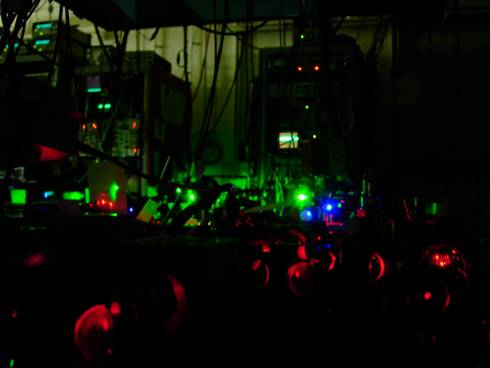
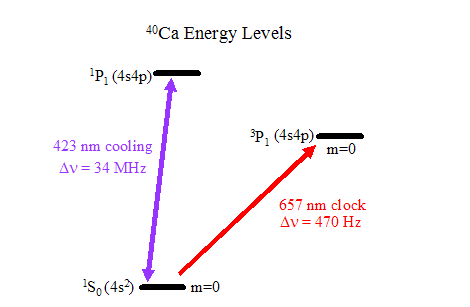
By virtue of their much higher oscillation frequencies, optical frequency standards have tremendous potential for improvement over their microwave counterparts, which have served as the primary standards for the past 50 years.� In our group we are developing the next generation of atomic frequency standards/clocks, based on optical transitions in laser-cooled neutral atoms.� In particular our work has focused on a clock that uses a narrow transition (natural linewidth 470 Hz) in calcium.� This transition, the 1S0 → 3P1 intercombination line at 657 nm, is particularly well-suited for standards work, due to its convenient wavelength and extreme insensitivity to external fields and other perturbations.� In order to have ms interaction times and reduced Doppler shifts, we have constructed a compact magneto-optic trap for Ca atoms based on a frequency-doubled diode laser system at 423 nm.[1]� With this trap we can load millions of atoms in tens of milliseconds, but in order to avoid unwanted Stark shifts, we actually release the atoms before probing the clock transition.� We perform the high resolution spectroscopy on the clock transition with a diode laser at 657 nm, which is locked tightly to a narrow fringe of an environmentally-isolated Fabry-Perot cavity (resultant laser linewidth < 10 Hz).� To maintain a high signal-to-noise ratio at high resolution, we use Bord�-Ramsey saturation spectroscopy combined with a shelving detection technique.� With this approach we have resolved features as narrow as 200 Hz wide, although we usually work at resolutions of ~700 Hz for frequency standards work.� We then employ a feedback system to keep the laser frequency fixed on the atomic resonance.� Since optical frequencies are too high to count directly, we use a mode-locked fs laser comb to divide our calcium frequency down to the countable microwave regime.� This allows us to operate the system as a clock and to make direct comparisons with the NIST cesium fountain and other standards under development.[2]� These comparisons will enable tests of fundamental physics such as a search for drifts in the fundamental constants.
 �������
Results
and Prospects
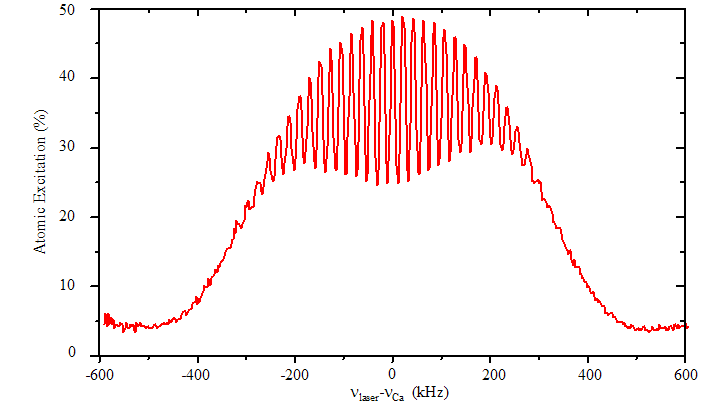
With the laser-cooled calcium system we have demonstrated the lowest instability measured for an atomic frequency standard (4x10-15 @ 1s)[3] and an absolute inaccuracy of 20 Hz (at 456 THz).[4,5]� Our measured values for this transition are in good agreement with those measured by the calcium group at Physikalisch Technische Bundesanstalt (PTB).� Since these measurements were limited by residual Doppler effects associated with motion of the freely expanding cloud of cold atoms, we have implemented a second stage of three-dimensional quenched narrow-line laser cooling that reduces the temperature of the atomic sample from 2 mK to below 10 mK.[6]� Due to the reduced Doppler contribution of the microkelvin atoms, the spectra are now Fourier transform-limited with all atoms contributing nearly equally to the observed lineshapes (see the Bord�-Ramsy spectroscopic signal shown below taken with a resolution of 11.55 kHz).� A recent investigation into the spectral envelope shown reveals that the asymmetry results from atomic recoil effects intrinsic to the spectroscopy.[7]� When combined with improved probe laser beam parameters (produced via atom interferometric measurements), this temperature reduction should enable an inaccuracy of less than 50 mHz (or 10-16) and a fraction frequency instability of 10-16 @ 1s, which would represent considerable improvement over present atomic standards.� This research also indicates that the use of even narrower transitions could lead to further improvement in neutral atom optical frequency standards.
��������
References (click on hyperlinks for pdf versions of the manuscripts) or visit the Division publication site for a updated listing of publications describing this work:
[5] "Quenched narrow-line laser cooling of 40Ca
with application to an optical clock based on ultracold neutral calcium
atoms", Ph.D. Thesis,
[7] C. W. Oates, G. Wilpers, and L. Hollberg, �Observation of Large Atomic-Recoil Induced Asymmetries in Cold Atom Spectroscopy�, arXiv physics/0401011.
Chris Oates, NIST ([email protected])